Aftermarket replacements for John Crane Type 2100 standard / L1S | 2100L1K | 2100L1N
The Luwint M2100 range comprises unitised, single-spring elastomer bellows mechanical seals in three working-length configurations. M2100S, M2100K and M2100N provide selection options for pump repairs where shaft size, available axial space and stationary-seat dimensions must be matched.
For Australian pump service workshops, maintenance teams and equipment owners, selecting the correct version starts with the existing seal and its installation dimensions. A matching shaft diameter alone does not establish suitability.
Why Choose the M2100 Range
-
Unitised rotary construction: keeps the rotary components together for straightforward handling during replacement.
-
Single coil spring: provides axial loading to maintain contact between the sealing faces.
-
Elastomer bellows design: combines shaft sealing with axial flexibility.
-
Three working-length options: helps match different installation spaces within the same seal family.
-
Material choices: allows face and elastomer combinations to be selected for the liquid and operating conditions.
Choosing the Correct Model
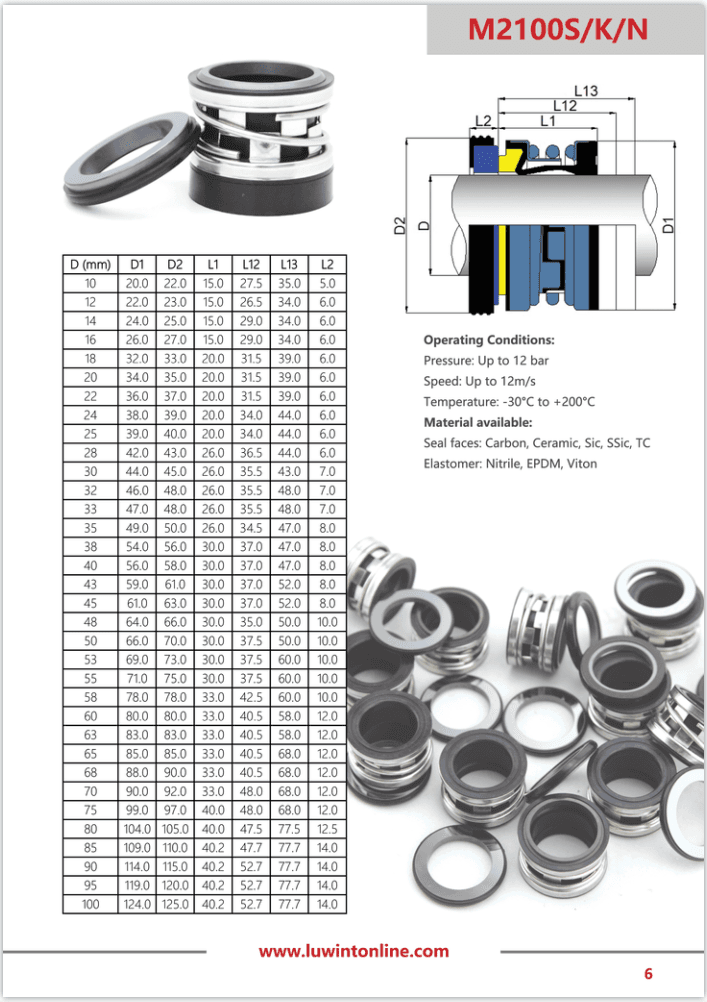
The S, K and N versions have different rotary working lengths. At a given shaft size, M2100S is the shortest, M2100K is intermediate and M2100N is the longest.
| Luwint model | Length designation in the Luwint drawing | Configuration |
|---|---|---|
| M2100S | L1 | Short rotary working length |
| M2100K | L12 | Intermediate rotary working length |
| M2100N | L13 | Long rotary working length |
For example, at a 25 mm shaft diameter, the catalogue lists rotary working lengths of 20 mm for M2100S, 34 mm for M2100K and 44 mm for M2100N.
These dimensions exclude the stationary seat. Check the complete installation arrangement, seat outside diameter, seat thickness and housing recess before ordering. Working lengths vary with shaft size.
Typical Operating Conditions
| Parameter | Catalogue range or limit |
|---|---|
| Shaft sizes listed | 10–100 mm, in selected metric sizes |
| Pressure | Up to 12 bar |
| Sliding speed | Up to 12 m/s |
| Temperature | −30°C to +200°C |
Actual operating limits depend on the face combination, elastomer, liquid and duty. Maximum pressure, speed and temperature should not be assumed to apply simultaneously. Confirm suitability for the specific application.
Common Cross-References
| Luwint | Corresponding John Crane reference |
|---|---|
| M2100S | Type 2100 standard / L1S configuration |
| M2100K | Type 2100L1K |
| M2100N | Type 2100L1N |
These references identify the corresponding seal family and length configuration. Confirm the actual rotary dimensions, stationary seat and materials before selecting an aftermarket replacement.
Where It Is Used in Australia
With suitable materials and a verified dimensional match, the M2100 range can be selected for:
-
Clean-water transfer and circulation pumps
-
Irrigation and agricultural pumping systems
-
Building-services and cooling-water circulation
-
Wastewater transfer duties, subject to solids and abrasion assessment
-
General industrial liquid-transfer applications
Selection should account for fluid chemistry, solids content, operating temperature and seal-chamber pressure.
Materials Available
Catalogue material options include:
-
Seal faces and stationary seats: Carbon, Ceramic, Silicon Carbide (SiC), Sintered Silicon Carbide (SSiC) and Tungsten Carbide (TC).
-
Elastomers: Nitrile (NBR), EPDM and Viton (FKM).
The appropriate face pairing and elastomer depend on the liquid and service conditions. Contact Luwint to confirm the available combination for your size and model.
Sydney Supply. Help with Selection.
Contact Luwint for current availability, pricing and dispatch timing.
For help identifying a replacement, send your pump make and model, shaft diameter, clear photos of the old seal and its key dimensions. Include the rotary working length, stationary-seat dimensions, liquid, operating temperature and pressure.
Ask us for the full PDF catalogue and the M2100 dimensional drawing.
Contact: Wayne Liao
Email: wayne@luwintonline.com
Mobile: 0433 986 633
LUWINT supplies aftermarket replacement products for original equipment applications. We are an independent supplier and are not affiliated with or endorsed by John Crane. Brand names and model references are used solely for identification and cross-reference.